

Other Treatments
Premium seramik · CAD/CAM üretim
Dental Crowns
A protective dental crown treatment that strengthens and restores function to decayed, broken or root-canal-treated teeth.
- Material
- Clinical standard
- Duration
- 3-5 days (completed in 2 clinic visits)
- Anesthesia
- Local anaesthesia
- Recovery
- 2-4 days of mild sensitivity
What Is It?
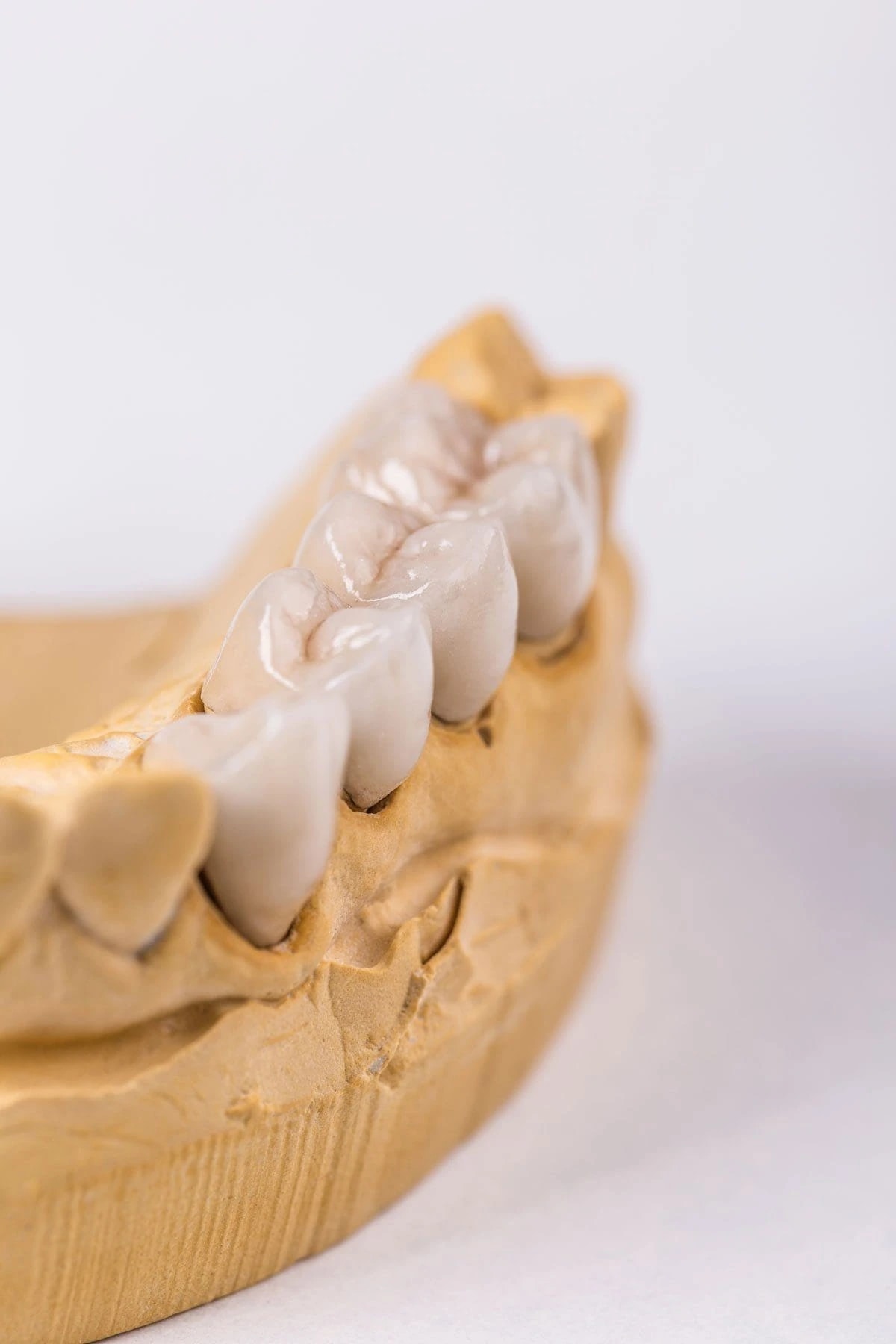
A dental crown is a custom-made, fixed restoration that covers the entire visible portion of a natural tooth. It is often described as a "cap" for the tooth. The goal is to strengthen a tooth that has been structurally weakened, fractured, cracked or root-canal treated, restore its chewing function, and provide an aesthetically natural appearance that blends with the surrounding teeth.
Unlike a filling, a crown does not just repair a single area of the tooth — it covers the entire visible surface. A filling fills in a small missing portion and relies on the remaining tooth structure for support; but when a large portion of the tooth structure has been lost, the remaining surface can no longer safely withstand chewing forces, and the risk of cracking or fracturing over time increases significantly. This is where a crown comes in: by wrapping around the remaining tooth structure as a single unit, it distributes chewing forces more evenly and provides comprehensive support. A crown sits on the tooth's own natural root, which distinguishes it from a crown placed on top of a dental implant (implant-supported crowns are a separate topic; this page focuses on crown treatment for natural teeth).
In modern dentistry, crowns can be manufactured from several different materials: zirconia, Emax (glass-ceramic), or metal-ceramic. Zirconia is often preferred for back molars and more extensive cases thanks to its high strength, while Emax offers a more natural aesthetic result for front teeth due to its light transmission properties. Metal-ceramic crowns, a long-established and durable option, remain a more affordable alternative that is still used today. The choice of material is made together with your dentist, based on the tooth's position (front/back), chewing forces, aesthetic expectations and budget. While this page refers you to our material-specific pages (such as full ceramic crowns or zirconia veneers) for detailed information, it aims to answer the broader question of "when and why is a dental crown needed" comprehensively.
Dental crown treatment is one of the most established and widely performed restorative treatments in dentistry. Having been used for decades, this treatment approach now delivers far more aesthetic, durable and comfortable results thanks to advances in materials and manufacturing technology. At our clinic in Alanya, we offer crowns produced using digital planning and modern laboratory technology to protect your damaged or weakened teeth and achieve a long-lasting, natural-looking result. Our international patients can benefit from this service during a short trip, combining their treatment with their holiday.
The need for a dental crown usually doesn't arise from a single sudden trauma but rather from a cumulative process over time. For example, a large filling placed years ago may gradually leak at its margins, allowing new decay to develop underneath. If left unnoticed, this decay can deepen and reach the tooth's nerve, at which point both root canal treatment and a crown become necessary. Similarly, a patient with a habit of clenching or grinding their teeth at night (bruxism) may experience gradual wear on the biting edges and chewing surfaces of their teeth over the years, leading to both aesthetic and functional problems. Catching these cumulative processes early can allow the issue to be resolved with simpler, less invasive treatment options — which is why regular dental check-ups are so important.
Advantages
Structural reinforcement:
A crown supports a weakened or brittle tooth against chewing forces, significantly reducing the risk of fracture.
Restoring function:
A broken or worn tooth regains normal chewing function through a crown, allowing everyday functions like speaking and biting to be carried out comfortably.
Aesthetic improvement:
Crown materials — particularly zirconia and Emax — can restore the tooth's colour, shape and length to a natural appearance, creating a harmonious smile with adjacent teeth.
Long-lasting solution:
With the right material choice and care, crowns can be used for 10-20 years without issue, helping preserve natural tooth structure and avoid extraction.
Protects root-canal-treated teeth:
Teeth become more brittle after root canal treatment; a crown protects these teeth against daily chewing forces, securing the long-term success of the treatment.
Compatible with other treatments:
Crowns can also be used as part of more comprehensive treatment plans, such as bridges or implant-supported restorations.
Resistant to staining:
Ceramic-based crowns in particular are more resistant than natural enamel to staining from tea, coffee and tobacco.
Indirectly protects neighbouring teeth:
Repairing a broken or sharp-edged tooth also eliminates the risk of it damaging the tongue, inner cheek, or opposing teeth.
The magnitude of these advantages naturally depends on the tooth's starting condition and whether the treatment is carried out at the right time. A crown planned early can prevent further loss of tooth structure, allowing you to achieve a result with a less invasive intervention.
Disadvantages
In the interest of transparency, we also want to share the limitations of this treatment:
Requires loss of tooth structure:
During crown preparation, a certain amount (usually 1-2 mm) of natural tooth structure is removed; this process is permanent and irreversible.
May create a need for additional treatment:
In cases requiring preparation close to the tooth's nerve, root canal treatment may become necessary afterwards; this cannot always be predicted in advance.
May change over time:
Gum levels can shift over time, potentially making the crown margin visible, which may rarely require a revision.
Cost:
Crown treatment is more expensive than a simple filling, though its long lifespan often makes it a worthwhile investment in the long run.
Requires maintenance:
Careful brushing and flossing, particularly around the crown margin, are needed to prevent plaque build-up.
Not suitable for every case:
For teeth with severe root loss or insufficient tooth structure, extraction and implant placement should be considered instead of a crown.
Your dentist will explain the advantages and disadvantages specific to your tooth's condition during your initial examination, and together you will determine the most suitable treatment path.
Risks
Dental crown treatment is generally a safe and predictable procedure, but there are some risks worth understanding. During tooth preparation, work may occasionally need to be done close to the tooth's nerve; in such cases, post-treatment sensitivity can increase, and root canal treatment may become necessary in some instances. Micro-leakage developing at the crown margin over time can lead to secondary decay underneath; this risk is significantly reduced through regular dental check-ups.
Rarely, the crown cement may loosen or the crown itself may crack; such cases are addressed under the clinic's treatment guarantee. For patients with a habit of clenching or grinding their teeth, using a night guard is strongly recommended to extend the crown's lifespan. Some patients may experience a temporary sensation of the tooth feeling "too high" in the first few days after placement; this is a normal part of the mouth adjusting to the new bite relationship and usually resolves within a few days. If this sensation persists longer than a few days, or if noticeable discomfort continues while biting, contacting your dentist for a fine adjustment is recommended. A definitive risk assessment is provided individually after a clinical examination and imaging, and this content does not constitute medical advice.
How Is It Performed?
- 1
Examination and imaging:
Digital X-rays (and CBCT if needed) are used to assess the tooth's root structure, surrounding bone, and any existing infection. This step is critical for identifying any additional treatment needed before the crown.
- 2
Completion of preliminary treatments:
If needed, root canal treatment, gum therapy or decay removal is carried out at this stage. A crown is never placed on a tooth without a healthy foundation.
- 3
Tooth preparation:
Under local anaesthesia, a thin layer of the tooth surface is shaped to the thickness needed for the crown to fit. This step is carried out with precise measurements depending on the crown type.
- 4
Impressions:
A digital intraoral scanner or traditional impression material is used to capture the shape of the prepared tooth, which is then sent to the laboratory. Digital scanning offers a more comfortable and more precise alternative.
Technologies Used
Our clinic uses digital X-ray and, when necessary, CBCT (three-dimensional tomography) imaging to thoroughly assess root structure and bone tissue. These imaging methods detect root-tip infections, bone loss, or hidden decay that would not be visible to the naked eye, ensuring the treatment plan is built on accurate information.
During the impression stage, digital intraoral scanners offer a more comfortable and precise alternative to traditional impression material, while also speeding up digital data sharing with the laboratory and reducing the margin of error in production. CAD/CAM (computer-aided design and manufacturing) technology is used in crown production, allowing the crown to be manufactured with millimetre-level precision in both shape and bite alignment. For cases requiring root canal treatment, rotary endodontic instruments and apex locator devices are used to complete the procedure safely and precisely. Digital shade guides and photography systems also help ensure the crown is produced with an excellent colour match to neighbouring teeth.
Zirconia blocks used in crown manufacturing undergo a sintering (firing) process under high heat and pressure to achieve their final strength; this process makes up part of the laboratory production time. During digital design, the dentist and laboratory technician plan the crown's thickness, occlusal surface and colour transitions on a computer with millimetre-level accuracy, resulting in a faster and more error-free production process. Compared with traditional casting methods, CAD/CAM technology achieves sub-millimetre precision in how the crown fits onto the tooth, meaning both a better bite and less of a gap at the crown margin — which reduces the long-term risk of decay and leakage, positively affecting the crown's overall lifespan.
How Many Days Does It Take?
A standard dental crown case is completed within 3 to 5 days across 2 clinic visits. This may extend if additional procedures such as root canal or gum therapy are required; root canal treatment, for example, typically requires 1-2 additional clinic sessions. For cases involving crowns on multiple teeth (such as bridge treatment), the total timeline generally stays within the 5-7 day range.
The exact timeline is confirmed during your free consultation, based on the photos and X-rays you share with us in advance. Many of our patients travelling to Alanya combine this period with their holiday, using the laboratory production time to explore the city or simply relax.
Treatment Process
At our clinic in Alanya, dental crown treatment for our international patients is typically planned as a 3-5 day programme spanning 2 clinic visits. On the first day, an examination, digital imaging, any necessary preliminary treatments (such as root canal treatment) and tooth preparation are carried out. Laboratory production takes 2-4 days, during which you can relax at your hotel with VIP transfers arranged, and explore Alanya's beaches and historic sites. Once the crown is ready, your final clinic visit completes the permanent placement.
For cases requiring multiple crowns (for example, combined with bridge treatment), the process may extend by a few days; this will be clarified during your free consultation. Your patient coordinator stays in touch with you throughout the process, arranges your appointments around your flight schedule, and offers suggestions for things to do in the city while you wait for the laboratory process to finish. For patients travelling from within Turkey or from abroad, the treatment schedule is designed to be as flexible as possible to suit your travel plans.
Recovery Process
Recovery after dental crown treatment is generally short and comfortable. Points to keep in mind include:
Mild sensitivity to hot and cold in the first 24-48 hours is normal and typically resolves on its own,
While the temporary crown is in place, it's best to avoid very hard or sticky foods (chewing gum, caramel, hard nuts),
Avoiding aggressive brushing around the temporary crown area and being careful with flossing, to reduce the risk of it dislodging,
After the permanent crown is placed, avoiding very hard foods for the first few days and allowing a short period to adjust to the tooth's new height,
Continuing regular brushing and flossing, paying particular attention to the crown margin,
Using a night guard as recommended by your dentist if you have a teeth-grinding (bruxism) habit,
Contacting our clinic promptly through our digital communication channels if you experience any pinching, pain or discomfort.
These simple precautions support both the crown's longevity and a comfortable recovery process. Most patients return to fully normal chewing and speaking function within a few days of the permanent crown being placed.
For long-term maintenance, your crowned tooth requires the same regular brushing, flossing, and six-monthly professional check-ups as your other teeth. Although a crown is as resistant to decay as natural enamel, the natural tooth structure at the gum margin where the crown ends still carries a risk of decay; paying special attention to this area is one of the most important factors in ensuring your crown's long-term success.
Why Choose Us?
A dental team with extensive international patient experience, using digital planning technology,
Crowns manufactured with millimetre-precision CAD/CAM technology,
A transparent, written and guaranteed treatment plan,
VIP airport transfer and accommodation arrangements,
24/7 patient coordinator support throughout and after your treatment,
An accredited clinical environment operating under the Health Tourism Authorization Certificate,
The ability to address additional needs — such as root canal treatment or gum therapy — at the same clinic during a single trip,
Fast support under our clinical guarantee for rare issues such as crown loss or cement loosening.
Price Overview
From
from €250
Depends on the chosen material (zirconia, Emax, or metal-ceramic) and the preparation needs of the tooth.
Treatments
Frequently Asked Questions
Treatments
Related Treatments


Free initial assessment
Let's build your treatment plan together after a clinical assessment.
Free Consultation WhatsApp