

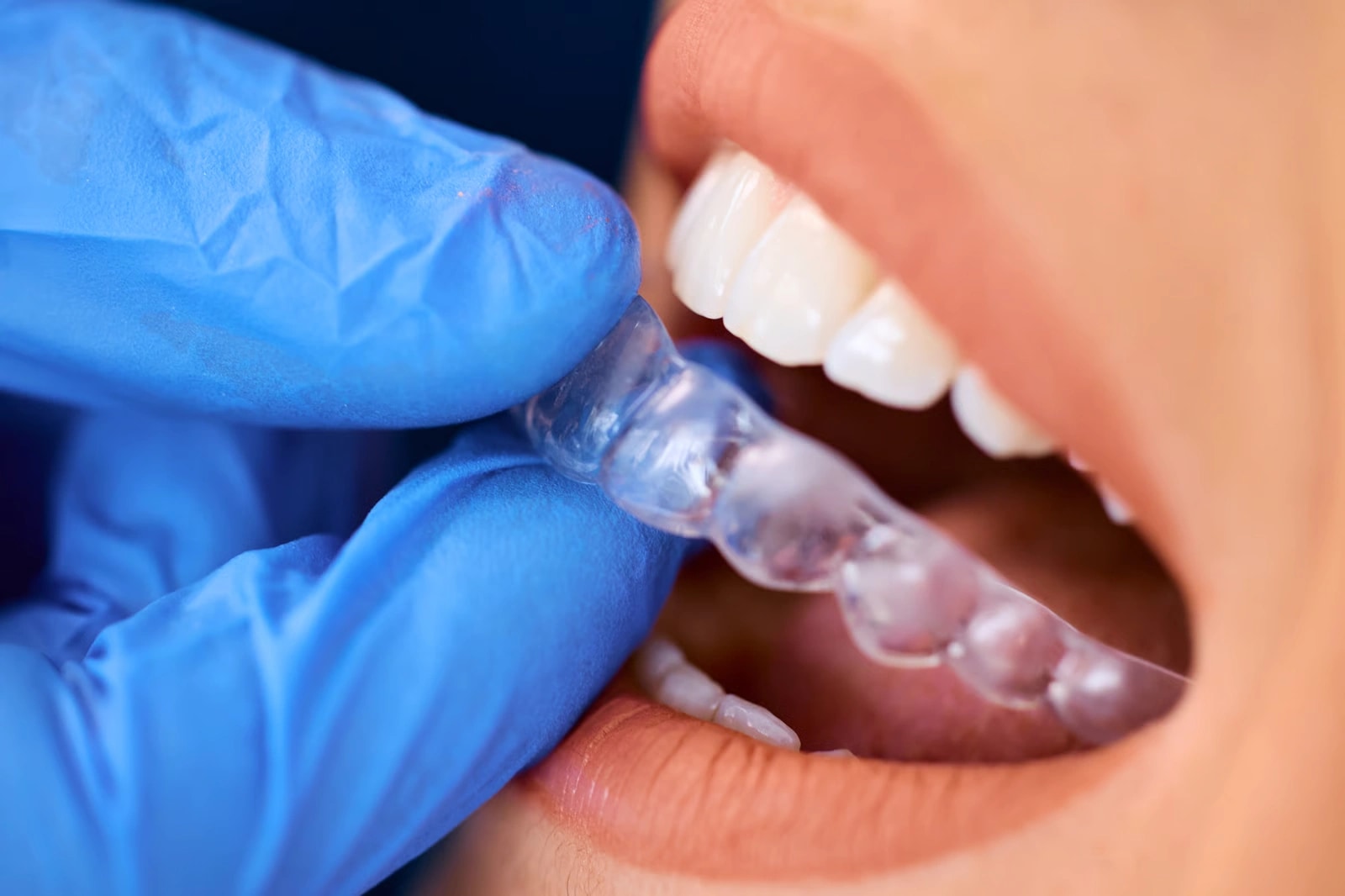
Hollywood Smile
Teeth Whitening
Clinic-supervised professional teeth whitening that safely lightens your teeth by several shades in a single visit.
- Material
- Premium porcelain
- Duration
- 1 day (single session, 60-90 minutes)
- Anesthesia
- Not required
- Recovery
- 24-48 hours of mild sensitivity
What Is It?
Teeth whitening is a procedure that lightens colour changes accumulated in natural tooth enamel over time, using dentist-supervised whitening agents — typically hydrogen peroxide or carbamide peroxide-based gels. The goal is to achieve a brighter, more radiant smile safely and naturally, without damaging the underlying tooth structure.
Over the years, our teeth tend to yellow or darken due to tea, coffee, red wine, tobacco, certain medications, and the natural ageing process. The porous structure of tooth enamel allows these staining compounds to penetrate the tooth surface. Professional whitening gels break down these pigments at a molecular level, producing a visible lightening of the tooth colour.
Tooth discolouration can be broadly divided into two categories: extrinsic staining and intrinsic staining. Extrinsic staining develops on the tooth surface as a result of tea, coffee, red wine, tobacco, dark sauces and inadequate oral hygiene, and generally responds very well to professional whitening. Intrinsic staining, on the other hand, occurs within the dentin layer beneath the enamel, often caused by certain antibiotics used in childhood (tetracycline group), excessive fluoride intake (fluorosis), or discolouration following dental trauma. These deeper stains may respond only partially to whitening, and in some cases an alternative aesthetic solution such as porcelain veneers may be more suitable.
Unlike over-the-counter whitening strips or pens, professional in-clinic whitening is both more effective and safer, thanks to gum protection, controlled gel concentration and dental supervision throughout the process. Over-the-counter products use low gel concentrations for safety reasons and offer no gum protection, which limits their results and increases the risk of irritation with uncontrolled use. At our clinic in Alanya, we offer a fast, comfortable whitening protocol completed in a single session, specifically designed around the needs of our international patients, based on internationally recognised clinical whitening standards.
It is important to note that teeth whitening is not a "miracle" treatment, and results vary depending on a patient's genetic tooth colour, enamel thickness and the type of staining present. Not every patient starts from the same baseline — some patients have a naturally light yellowish enamel tone, while others have a greyer or brownish underlying shade. This genetic baseline determines the lightest shade that whitening can realistically achieve. Your dentist will discuss realistic expectations with you in detail during the pre-treatment examination, and together you will agree on a target shade using a digital shade guide.
There are also several different whitening methods available on the market: pharmacy-bought whitening strips and pens, charcoal-based toothpastes, whitening mouthwashes, and in-clinic professional treatment. The key difference between these options lies in the concentration of the active ingredient and the method of application. Pharmacy products contain very low concentrations of hydrogen peroxide for safety reasons, which means results tend to be limited, uneven and often temporary. Charcoal-based products do not create a genuine chemical whitening effect; they simply lighten surface stains through an abrasive action, which carries a risk of enamel damage with prolonged use. Professional in-clinic whitening, by contrast, allows higher-concentration agents to be used safely under dental supervision, delivering measurable and predictable results.
Advantages
Fast and effective results:
A noticeable colour improvement is achieved in a single clinic session lasting approximately 60-90 minutes.
Painless and non-invasive:
No cutting, anaesthesia, or removal of tooth structure is required.
Preserves natural tooth structure:
Only the colour is targeted; the structural integrity of the enamel is untouched.
Boosts confidence quickly:
A visible, fast aesthetic improvement makes it a popular choice ahead of social events.
An affordable aesthetic solution:
Considerably less expensive than veneer or crown-based treatments.
Personalised concentration:
Gel concentration and application time can be adjusted according to your sensitivity level.
Compatible with other cosmetic treatments:
Whitening is often used as a reference point for future crown or veneer treatments, helping determine a matching shade.
Quick preparation for photos and videos:
It can be performed just a few days before an important event, such as a wedding, graduation, or job interview.
Disadvantages
In the interest of transparency, we also want to be clear about the limitations of this treatment:
Results are not permanent:
Colour can gradually darken again depending on your diet; periodic top-up sessions may be needed.
Crowns and fillings do not change colour:
If you have existing restorations in a visible area, a colour mismatch may appear after whitening your natural teeth.
Temporary sensitivity:
Sensitivity to hot and cold for 24-48 hours after treatment is a common side effect.
Not all stains respond equally:
Deep intrinsic staining from tetracycline use or fluorosis-related white spots respond less predictably than surface staining.
Risk of unrealistic expectations:
Results remain within the genetic limits of your natural tooth colour; a "paper white" appearance is not achievable or desirable for every patient.
Risk of uneven results:
In rare cases, different teeth may respond at slightly different rates; this can be balanced out with an additional application session.
Your dentist will assess your tooth colour and staining type at your initial examination to help set realistic expectations for your result. Managing expectations is one of the most important factors in patient satisfaction with this treatment, which is why a "realistic target shade" is agreed together using a digital shade guide before treatment, along with a clear explanation of the achievable range.
Risks
Professional, dentist-supervised teeth whitening is generally a very safe procedure, but there are some risks worth understanding. The most common side effect is temporary tooth sensitivity lasting 1-2 days after treatment. Gum irritation is rare and is largely prevented by proper application of the protective barrier. Excessive or unsupervised whitening — particularly with over-the-counter products — can increase enamel sensitivity over time, which is why unsupervised products are not recommended. Any existing cavities, cracks, or areas of gum recession should be assessed separately before whitening.
Another important point is expectation management: some patients, influenced by the extremely white smiles they see on social media, may expect an unrealistic result. It is worth remembering that such images are often the result of digital filters or porcelain veneers, and that natural teeth whitening has its own limits. During your examination, your dentist will show you concrete examples using a digital shade guide of the result that is realistically achievable for your specific tooth structure — this transparency is one of the most important steps in preventing post-treatment dissatisfaction, and is one of the key benefits of working with an experienced dentist. A definitive risk assessment is provided individually after a clinical examination, and this content does not constitute medical advice.
How Is It Performed?
- 1
Examination and shade assessment:
Your dentist records your current tooth shade using a standardised shade guide and evaluates the type of staining present (surface or intrinsic).
- 2
Cleaning, if needed:
If surface plaque or tartar is present, a professional cleaning is performed beforehand, allowing the gel to penetrate the enamel more effectively.
- 3
Gum protection:
A protective barrier (resin or a dental dam) is applied to prevent the whitening gel from contacting the gum tissue.
- 4
Application of the whitening gel:
A professional-grade hydrogen peroxide-based gel is applied in a controlled manner to the tooth surface.
Technologies Used
Our clinic uses internationally certified, CE and FDA-approved professional whitening systems. Objective shade measurement is performed using a digital shade guide during the procedure; where appropriate, LED light-activation devices are used to enhance the gel's effectiveness. Prior to treatment, a digital intraoral camera — and digital X-ray imaging when necessary — is used to assess overall oral health. The gum protection barrier is applied using a light-cured, photo-polymerising resin material, which prevents any contact between the gel and sensitive gum tissue.
A digital intraoral camera allows before-and-after photos to be taken at a consistent angle and lighting, enabling an objective comparison of your results. In some cases, desensitising gels containing potassium nitrate or fluoride are also included in the treatment protocol to reduce sensitivity. All materials used are certified products that meet international dental safety standards.
These digital systems help us evaluate not only your whitening result but also your overall oral health. Digital X-ray imaging, for instance, can detect cavities or root-tip infections that are not visible to the naked eye, allowing any necessary treatment to be planned before whitening begins. This holistic approach safeguards not only your aesthetic outcome but also your long-term dental health.
How Many Days Does It Take?
Standard professional teeth whitening is completed in a single day, within one clinic session (60-90 minutes). It does not require additional overnight stays or multiple visits, making it a very practical treatment for patients planning a short trip to Alanya. For cases with deeper discolouration, your dentist may recommend a complementary at-home whitening kit, which you can use over 1-2 weeks in your home country following the dentist's instructions to further optimise the result.
This makes teeth whitening a particularly practical option for international patients with limited time: a patient visiting Alanya for a week-long holiday, for example, could complete their examination and whitening session on the first day, then spend the rest of their holiday enjoying the sun and sea with their new smile. If combined with other dental treatments (comprehensive cleaning, replacement of a filling, etc.), the total timeline may extend depending on the number of clinic visits required — this will be clarified during your free consultation.
Treatment Process
At our clinic in Alanya, teeth whitening for our international patients is typically arranged as a single-day appointment that fits easily into your holiday schedule. Based on the photos you share during your free online consultation, a preliminary assessment is prepared; VIP airport-to-clinic transfer is arranged, and the examination and whitening procedure can be completed on the same day. If you wish to combine whitening with another treatment (such as a comprehensive dental cleaning), this can be planned in advance to suit your travel itinerary. Before the procedure, a digital photo is taken to document your starting shade, and a comparison photo is shared with you afterwards.
Appointment times for patients travelling from different cities or abroad are scheduled flexibly around flight times. For example, a patient arriving early in the morning could complete an examination and cleaning before noon, then finish the whitening session in the afternoon and relax at their hotel that evening. Our clinic's convenient location, close to Alanya's beaches, historic castle and natural attractions, makes it easy to enjoy the rest of your holiday after treatment. Throughout the process, your patient coordinator can communicate with you in English, German, Russian and other languages in addition to Turkish.
Recovery Process
Because teeth whitening is a non-invasive procedure, "recovery" is minimal, but there are a few important points to keep in mind during the first 24-48 hours:
Avoiding staining foods and drinks such as tea, coffee, red wine, cola and tobacco during the first 24-48 hours (often referred to as the "white diet"),
Avoiding dark sauces (soy sauce, tomato-based sauces) and heavily pigmented foods during this period,
Rinsing with lukewarm water and using a desensitising toothpaste if you experience hot/cold sensitivity,
Continuing normal brushing and flossing while avoiding overly aggressive brushing,
Using a protective fluoride gel as recommended by your dentist, following the given instructions,
Avoiding tobacco products as much as possible in the first few days, as this reduces sensitivity and helps preserve your new shade for longer,
Favouring light-coloured foods (chicken, fish, rice, dairy products) to maintain a balanced "white diet",
Using a straw to reduce contact between dark-coloured drinks and your tooth surface, a practical option for patients who don't want to give these drinks up entirely,
Switching to a gentle, low-abrasion, fluoride toothpaste after treatment, which can help reduce sensitivity and preserve your result.
These simple precautions help shorten the duration of any sensitivity and extend the longevity of your results. To maintain your result long-term, we recommend a professional dental cleaning once or twice a year, along with any short top-up sessions your dentist may suggest.
Maintaining good overall oral health is the most effective way to extend the life of your whitening result. Brushing at least twice a day for two minutes, daily flossing, and a regular six-month dental check-up form the foundation of both your tooth colour and your overall dental health. Electric toothbrushes can be more effective than manual brushing at removing plaque. Avoiding frequent snacking on acidic or sugary drinks between meals also reduces the risk of cavities while helping enamel resist future discolouration.
Why Choose Us?
Teeth whitening may look like a simple treatment, but the right approach makes a real difference to the outcome. With the right dentist, the right protocol and the right aftercare routine, we aim to help you get the most satisfying result possible:
A dental team with extensive experience treating international patients, using up-to-date whitening protocols,
Objective, trackable results using digital shade analysis,
VIP airport transfer and hotel arrangements on request,
A flexible, single-day appointment that fits easily into your holiday schedule,
24/7 patient coordinator support throughout and after your treatment,
An accredited clinical environment operating under the Health Tourism Authorization Certificate,
Flexible appointment scheduling that easily combines with other dental or aesthetic treatments (comprehensive cleaning, veneers, implants) during the same trip.
Price Overview
From
from €150
Depends on the chosen method (standard in-office or LED/laser-assisted combined whitening) and the condition of the tooth surface.
Treatments
Frequently Asked Questions
Treatments
Related Treatments


Free initial assessment
Let's build your treatment plan together after a clinical assessment.
Free Consultation WhatsApp