

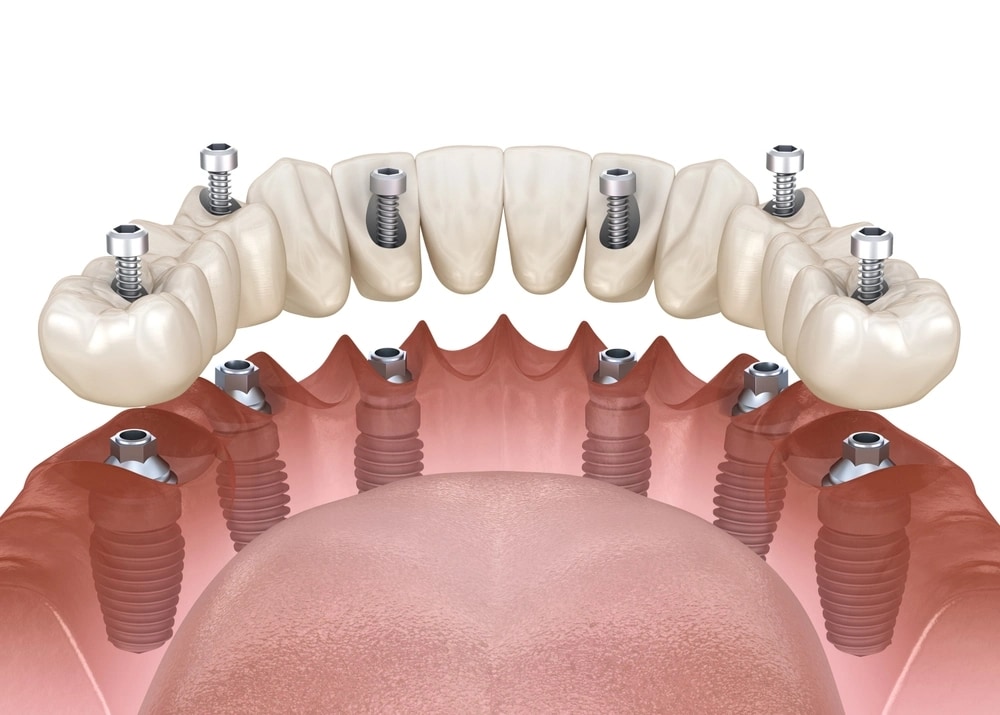
Dental Implant Treatments · All-on-6 Protocol
All On 6 Dental Implants
A full-arch fixed denture supported by 6 implants, offering enhanced stability for patients with a wider jaw or higher bite force needs.
- Full-arch plan with 6 implants
- Same-day temporary prosthesis
- Complete jaw rehabilitation
- Material
- Titanium dental implant
- Duration
- 3-6 days (fixed temporary denture in the same trip); permanent denture fitted on a second trip after 4-6 months
- Anesthesia
- Local anaesthesia (sedation or general anaesthesia available on request)
- Recovery
- 5-10 days soft-tissue healing, 4-6 months for full osseointegration
What Is It?
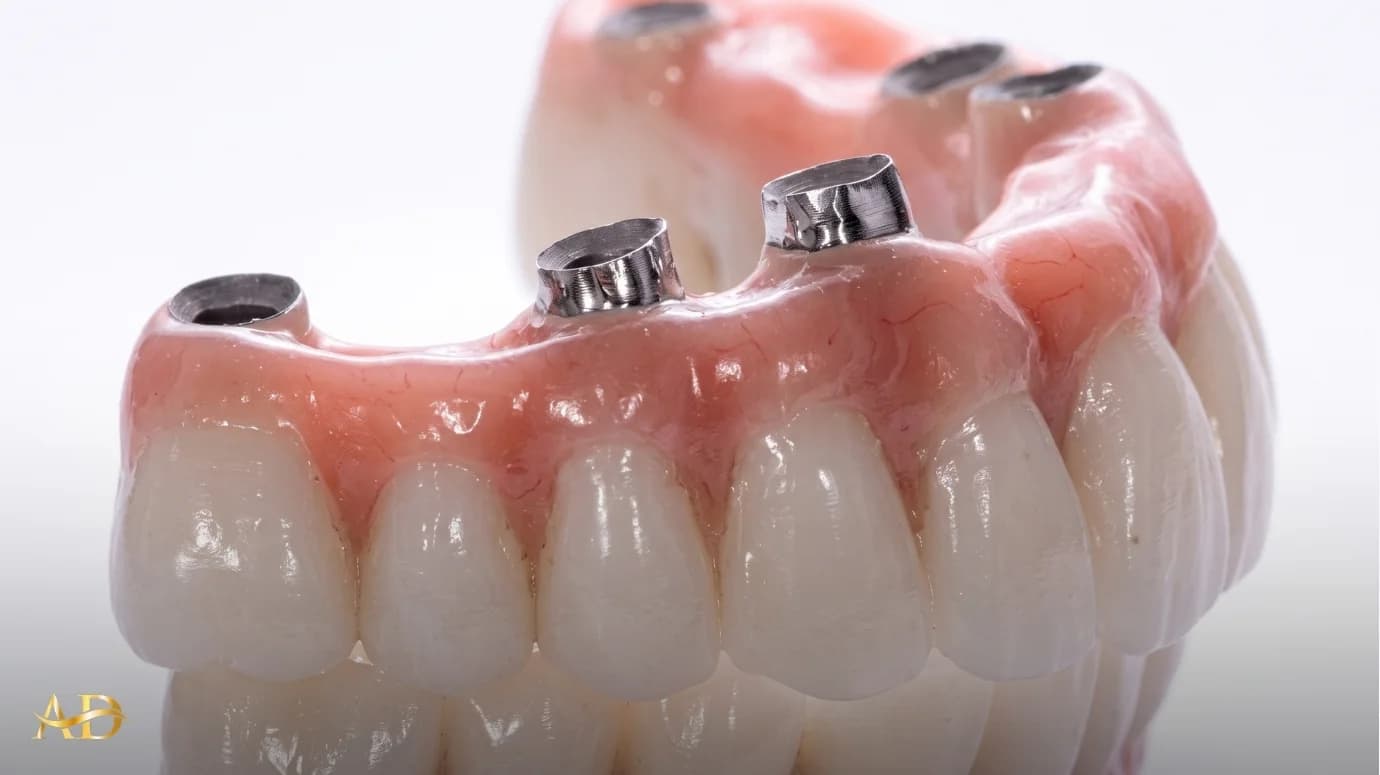
All on 6 is an implant protocol for patients missing most or all of the teeth in one jaw, in which a full arch of fixed teeth is supported using 6 implants. Developed as a logical extension of the All on 4 protocol, it shares the same core principle — a fixed, full denture supported by a minimal number of implants — but uses additional implants to create a wider support base and more balanced load distribution.
Using 6 implants, particularly in patients with more favourable bone volume and density, allows chewing forces to be distributed more evenly across the implants. This reduces the load carried by any single implant, which can theoretically further lower the risk of implant failure over the long term. A 6-implant structure also provides a margin of safety: in the rare event that one implant is lost, the remaining 5 can continue to temporarily support the denture — an option that's more limited when only 4 implants are used.
All on 6 is generally preferred for the upper jaw, since upper jawbone is naturally less dense than lower jawbone, and additional implants can provide a safer load distribution. That said, it can be applied to either jaw, and your dentist determines the ideal number of implants for your specific bone structure after 3D imaging.
When choosing between All on 4 and All on 6, your dentist considers not just bone volume but also your biting habits, jaw muscle strength, the condition of your opposing teeth, and your overall oral structure. For example, in cases where the opposing jaw has natural teeth generating strong bite force, having more support points on the implant side (All on 6) may be a safer long-term choice. Conversely, in cases where both jaws are treated with implants, the opposing bite force is more balanced, so All on 4 is often sufficient.
This clinical decision-making process is entirely individualised, and there's no single "correct" answer. Our goal is to present all options transparently, without pressure, and to reach the decision best suited to your bone structure, lifestyle and budget together. We find that patients make the most confident decisions when they understand not just the immediate cost difference, but also how each protocol is likely to perform over years of daily use.
This page covers how All on 6 differs from All on 4, who it's better suited for, the clinical steps involved, the recovery process, and pricing in Alanya.
Who Is It Suitable For?
All on 6 is particularly considered for patients who:
During assessment, your dentist reviews panoramic X-rays and 3D tomography images together to determine which implant count best suits your bone quality. In some cases, a mixed treatment plan may be recommended — for example, 6 implants in the upper jaw and 4 in the lower — reflecting the fact that each jaw's anatomy must be assessed independently.
Based on our clinical experience, one of the most common questions patients ask when deciding between All on 4 and All on 6 is what concrete difference the extra 2 implants will make in daily life. The answer largely depends on your bone quality and chewing habits: for some patients the difference is barely noticeable, while for patients with a wider jaw or strong chewing muscles, the additional implants can noticeably improve denture lifespan and stability.
In patients with limited bone volume, the additional implants required for All on 6 can sometimes increase the need for bone grafting; in such cases, your dentist will compare All on 4 against a graft-supported All on 6 and recommend the option best suited to you. Systemic factors such as smoking and uncontrolled diabetes are also taken into account. Final suitability is determined after 3D tomography and a clinical examination.
- Have bone volume and density that allows for more implant support than All on 4,
- Have a wider jaw structure and need more distribution points on the denture,
- Have a history of bruxism (teeth grinding/clenching), which can place higher mechanical load on implants,
- Are missing most or all of the teeth in the upper jaw, where naturally lower bone density calls for additional support points,
- Prioritise a long-term safety margin, preferring a "more implants, more security" approach to treatment planning,
- Have previously had All on 4 treatment but experienced implant loss or stability issues and are seeking a revision treatment,
- Are medically fit for implant surgery and consider the additional cost acceptable in exchange for maximising denture lifespan and stability,
- View full-mouth rehabilitation as a long-term investment rather than a short-term fix.
Same-Day Teeth Concept
1 day
Surgery + fixed temporary prosthesis
6
Implants per arch (All-on-6 protocol)
3–6 mo
Healing before final prosthesis
24–48h
Soft diet period
How Is It Performed?
- 1
Clinical examination and 3D tomography:
Bone density, volume and anatomical limits (sinus, nerve canal) are assessed using a 3D CBCT scan.
- 2
Digital implant planning:
The exact position and angle of all 6 implants are determined using planning software; typically 4 implants are placed in the front-middle area and 2 angled implants at the back.
- 3
Necessary extractions:
Any remaining teeth that cannot be saved are extracted, either in the same session as implant placement or beforehand.
- 4
Implant placement:
Under local anaesthesia (sedation on request), the 6 implants are placed in the jawbone at the planned positions and angles.
All-on-8 vs All-on-4 vs All-on-6
All three protocols target a fixed full-arch prosthesis; they differ in implant count, load sharing and case selection.
All-on-4
- 4 implants per arch
- Angled posterior implants widen the support base
- Standard cases with limited bone volume
- Shorter surgery; typically lowest cost
All-on-6
- 6 implants per arch
- Extra support in the mid-posterior region
- Wide arches needing additional stability
- Moderate surgical scope and cost
All-on-8
- 8 implants per arch
- More support points along the arch
- Selected cases aiming for maximum support
- Largest surgical scope; not suitable for every patient
Technologies Used
3D tomography (CBCT):
Forms the foundation for detailed jawbone mapping and safe planning of all 6 implants.
Digital implant planning software:
The angle, depth and position of each implant are simulated on a computer before surgery.
Guided surgery templates:
Custom surgical guides based on digital planning allow implants to be placed with high precision.
CAD/CAM denture manufacturing:
Both temporary and permanent dentures are produced with precision using digital design and manufacturing systems.
Branded implant systems:
Systems such as Straumann, Nobel Biocare and Osstem, all backed by long-term clinical data, are used.
Zirconia denture technology:
Frequently used for permanent dentures, zirconia offers excellent aesthetics and durability.
Digital smile design:
The permanent denture's tooth size, shape and colour are digitally designed in advance to match the patient's facial structure.
Intraoral scanners:
Used for both temporary and permanent denture impressions, offering faster and more comfortable digital scanning.
Bringing this technology together allows for precise, safe planning of all 6 implants while significantly improving the predictability of the treatment process.
How Many Days Does It Take?
The first stage of All on 6 treatment (extractions, placement of 6 implants and fixed temporary denture) is typically completed within 3-6 days. Because the permanent denture requires full osseointegration, this process usually takes 4-6 months. Once osseointegration is complete, the second trip — for impressions, manufacturing and fitting the permanent denture — takes 3-5 days. In total, from the start of treatment to the fitting of the permanent denture, the process takes roughly 5-7 months; your fixed temporary denture gives you a normal smile and chewing function throughout this period.
Spending the waiting period between trips at home is entirely normal, and you can continue your daily life with your temporary denture. The progress of osseointegration can also be monitored via digitally shared images; if you notice anything unusual, we recommend contacting us before your second trip date.
Treatment Process
For our international patients, the All on 6 process begins with a digital assessment before travelling. On arrival in Alanya, you'll be met with a VIP transfer, and your first clinical day includes a detailed examination and 3D tomography scan. Necessary extractions and placement of the 6 implants are usually scheduled within 2-4 days during the same trip — somewhat longer than All on 4's surgical process. In suitable cases, you can return home with your fixed temporary denture in place.
Once osseointegration is complete (typically 4-6 months), a second trip of usually 3-5 days is arranged for the permanent denture. Accommodation, interpreter support and VIP transfers are provided on both trips. We recommend spending the first 2-3 days of your first trip focused on recovery near the clinic rather than active sightseeing, since a 6-implant surgical procedure may require somewhat more rest than All on 4.
Your patient coordinator carefully balances your clinic appointments with your recovery time when planning your itinerary. During your second trip, once permanent denture impressions are taken, you can use the laboratory production period (usually 2-3 days) to enjoy Alanya's attractions before your final check and fitting appointment.
Disadvantages
In the interest of transparency, we also want to share the limitations of All on 6:
More surgery than All on 4:
2 additional implants mean a somewhat longer surgical time and potentially a slightly more pronounced recovery process.
Higher cost:
The additional implants increase the total treatment cost compared to All on 4.
Bone volume limitations:
Some patients may not have sufficient bone volume for 6 implants; in these cases, a localised graft or switching to All on 4 is considered.
It is a surgical procedure:
Like all implant treatments, All on 6 involves surgical risk and a recovery period.
Long-term maintenance is essential:
Good oral hygiene and regular clinical check-ups are important to reduce the risk of peri-implantitis.
Your dentist will explain the difference between All on 4 and All on 6, and which is more suitable for your jaw structure, in detail during your initial assessment. When making this decision, we recommend considering not just your current needs but how your denture is likely to perform over the next 10-20 years.
Recovery Process
Swelling, bruising and sensitivity are expected in the first few days after All on 6 surgery; because 6 implants are placed, recovery may feel somewhat more pronounced than with All on 4. Our recommendations include:
- Applying ice regularly for the first 2-3 days,
- Completing the full course of prescribed antibiotics and pain relief,
- Sticking to soft, smooth foods for the first 2 weeks, avoiding hard or sticky foods,
- Avoiding excessive biting force on the temporary denture,
- Stopping smoking, or significantly reducing it, during recovery,
- Gentle brushing and regular use of the prescribed mouthwash,
- Avoiding strenuous physical activity during the first week.
Initial swelling and sensitivity generally improve significantly within 7-10 days, while full soft-tissue healing can take 2-4 weeks. Once you return home, follow-up support continues through our digital communication channels; if you experience anything unusual during the osseointegration period, you can share a photo or video for quick feedback.
Risks
While All on 6 is a protocol backed by long-term clinical data, it carries risks like any surgical procedure: temporary swelling and sensitivity, rare cases of infection, insufficient fusion of one of the implants, or wear on the denture over time. While using 6 implants provides an advantage in that the remaining implants can continue supporting the denture if one is lost, this doesn't eliminate surgical risk entirely. These risks are reduced through an experienced surgical team, appropriate case selection, and consistent aftercare. Any complications are addressed under the clinic's treatment guarantee. Over the long term, wear on the denture's artificial teeth or gum inflammation around an implant (peri-implantitis) can develop, which is why regular check-ups and professional cleaning are important. A definitive risk assessment is always provided individually after a clinical examination and imaging; this content is for general informational purposes only and does not constitute medical advice.
Why Choose Us?
A dental team experienced with international patients, using digital implant planning technology,
Precise, safe All on 6 surgical planning supported by 3D tomography,
VIP airport transfer and accommodation arrangements,
24/7 patient coordinator support throughout and after your treatment,
Accredited partner clinics operating under the Health Tourism Authorization Certificate,
Digital follow-up and second-trip planning support throughout the osseointegration period,
Transparent, personalised treatment planning that clarifies the difference between All on 4 and All on 6,
A single point of coordination for every patient, keeping every step of the process — before, during and after travel — transparent and easy to follow.
Dt. Selim Mert Şahinkaya and his team follow a detailed assessment process to determine the implant count best suited to each patient's bone structure and long-term needs; our goal is a treatment plan that prioritises long-term clinical success, not just the short-term result.
Price Overview
From
from €4200
Per jaw; varies by bone condition, implant brand and denture material.
Treatments
Frequently Asked Questions

Free initial assessment
Let's build your treatment plan together with CBCT imaging and a clinical assessment.
Free Consultation WhatsApp